Interoception: The Ground Floor of Everything We Call Emotional Awareness
"I keep feeling this grief. Again and again. I feel the rage, the despair, the flatness of feeling incompetent. I'm doing the work, I'm feeling my feelings — so why does nothing change?"
Such a fair question, and a common wound — one that took me years to understand myself, after multiple rounds of talk therapy with very minimal effect to relieve my then depression, anxiety and insecurity. I hear a version of it often, too, from the people I work with, both at the Symbiosis retreat and in one-to-one Somatic Inquiry sessions.
You might have heard that feeling equals healing. This is very true. But there's a deeper layer to it as well. Sometimes, if we simply stay present with the emotion and let it move through us, the loop closes on its own. But most times it doesn't. And the difference, I've come to believe, lives in a capacity many of us were never taught: interoception.
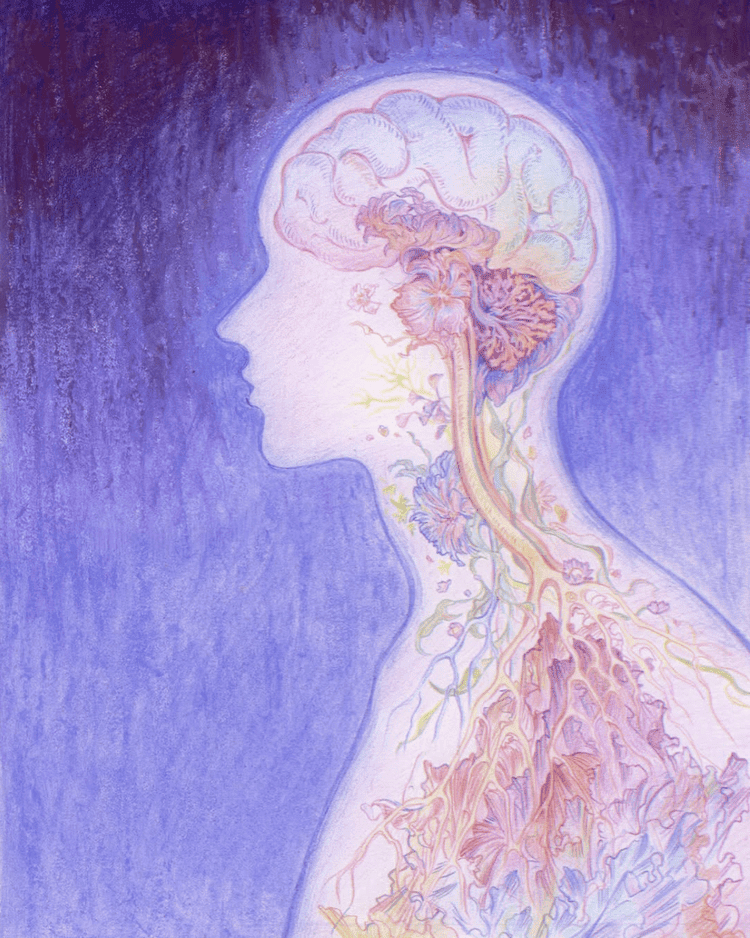
All art on this page is by @lumiarctur
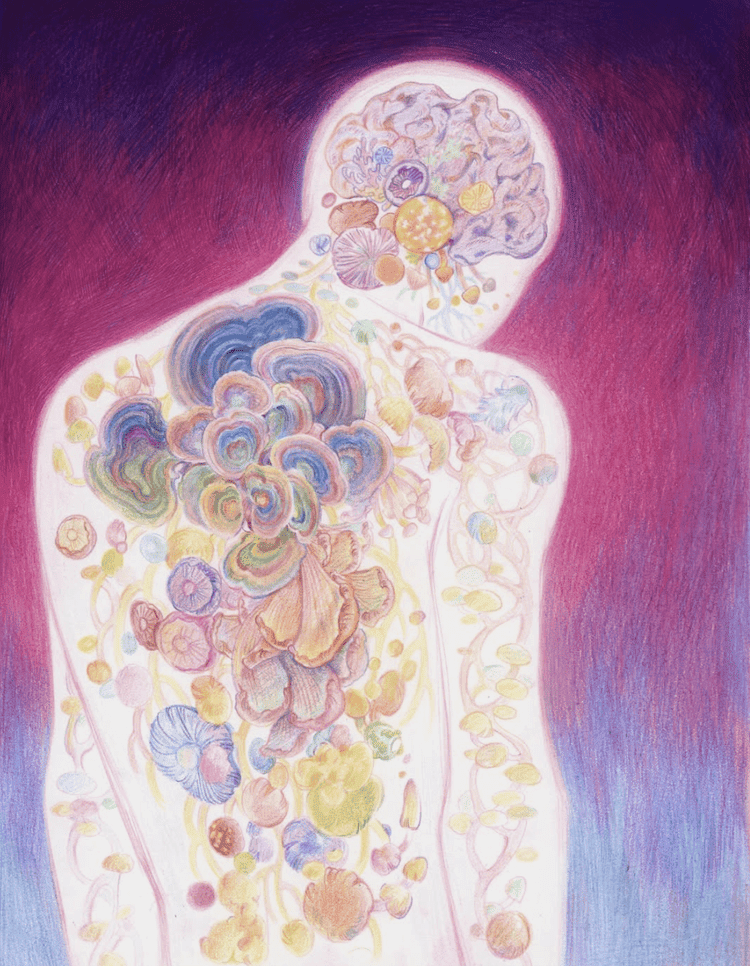
What is interoception
Interoception is the sense that lets us feel our own insides: the tightening in the chest right before tears arrive, the hollow drop in the stomach when we feel excluded, the heat that climbs the neck when shame flares up. It's the nervous system's inward-facing sense organ, as real and as trainable as sight or hearing, and it's the ground floor of everything we call emotional awareness. Without it, we're guessing at our own inner weather from the outside. With it, we can track a feeling as it rises, peaks, and — if held with enough awareness — changes.
Feeling a feeling is the first step. But if the sensation is only ever noticed and named, never met with compassion, it tends to circle rather than resolve. And no worries, you’re not broken; this isn't a failure of feeling, it’s just a feeling with nobody ‘‘home’’ to meet it.
Recognising a feeling is only half the arc; the tender, curious inquiry into what's actually happening in the body depends entirely on interoception. Without that inward resolution, the process can look like presence while we're actually stuck in a loop.
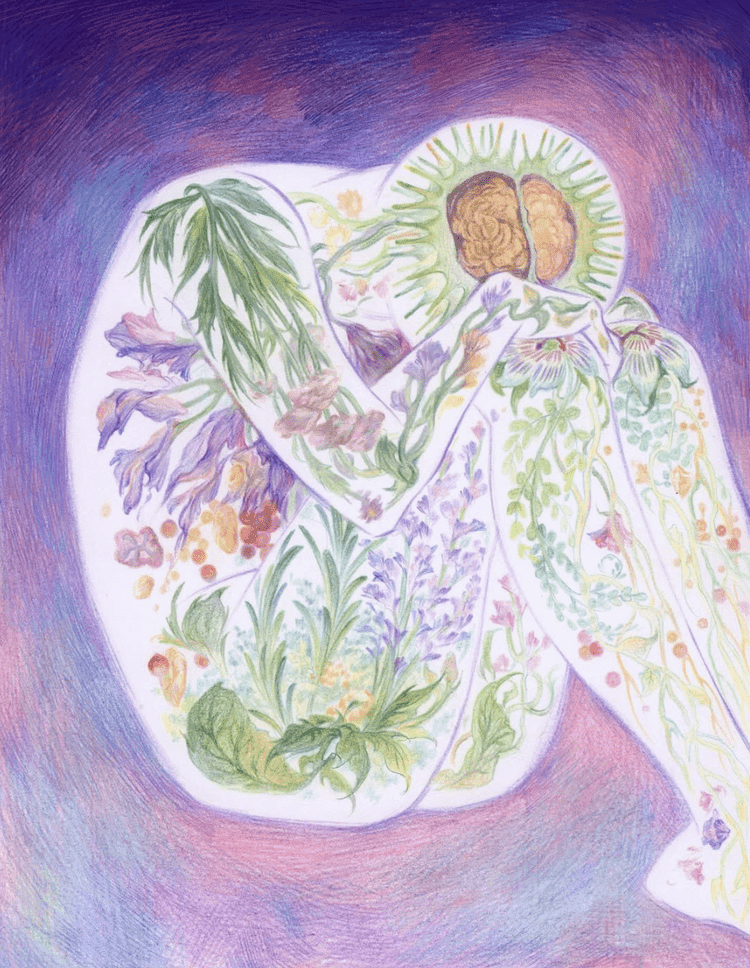
Why the sense itself goes offline
Often, because the body learned it wasn't safe to listen and feel.
When intense physical sensation has repeatedly preceded overwhelm — a racing heart before a parent's rage, a tight throat before ridicule, a hollow stomach before abandonment — the nervous system does something remarkably intelligent for us: it learns to route attention away from the body rather than into it.
Dissociation is awareness protecting itself, the only strategy available to a child who cannot leave the room and cannot change the parent, so leaves the body instead. Over time, that strategy becomes the default setting, and interoception doesn't so much fail to develop as get quietly switched off at the very source.
Invalidation
The same thing happens more subtly through invalidation. A child who signals, in its own language, "I'm scared" or "that hurt my feelings," and is met with "you're fine" or "you have nothing to be sad about," learns that the bodily signals they are sensing cannot be trusted, and that the safer move is to override them rather than translate or understand them. In our patriarchal society, this tends to hit boys and men particularly: "man up; toughen up," though their nervous systems are, of course, every bit as sensitive.
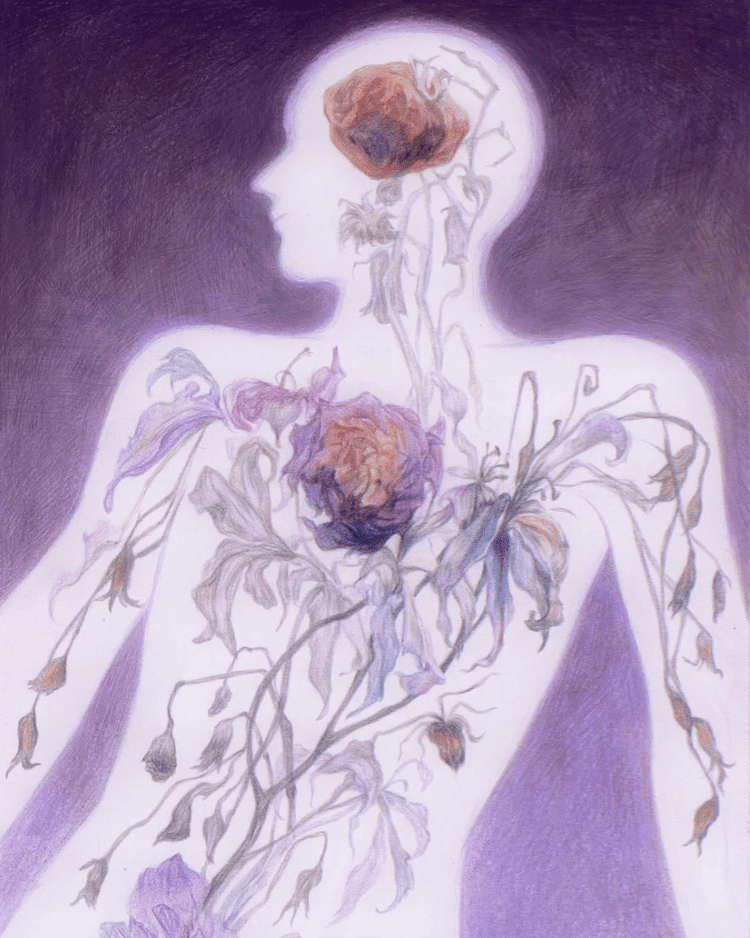
Repeated enough times, the felt sense stops functioning as information. This is often why I hear people describing their inner life in only two settings, flooded or numb, with very little felt texture in between.
And you know what? That that's not a personality trait. It's an interoceptive sense that was, so to speak, trained away from nuance and discernment, because nuance and discernment once were unbearable. If this is you, there was absolutely nothing wrong with your body's wiring. On the contrary, it did exactly what it needed to do to get you through; to survive an overwhelming situation you found yourself in at the time.
All art on this page is by @lumiarctur
Why the loop happens
The absence of an emotionally attuned other only explains half of it.
Biologically, as children, we don't yet carry the inner architecture to hold a big emotion alone — like all mammals, like all creatures who depend on the herd, we need a steadier being nearby, someone whose own calm can lend us borrowed ground until we find our own.
When that presence wasn't reliably there, the body’s intelligence found other ways, other tools to cope with the situation: it froze, adapted, felt something intensely without letting the wave complete, or stopped feeling it at all.
And so grief becomes a room we re-enter, rather than a wave we ride. The inner sentence isn't "a part of me is grieving" — it's "I am abandoned." Full stop. No distance, no witness. That sentence rarely originates with us; it was narrated into us long ago, by the voices we heard most often as children. When there's no separation between self and emotion, there's nowhere for the emotion to go — it simply repeats the only shape it knows. Our psyche is in complete identification with the suffering part.
This is where, in my personal experience, the nondual and Buddhist traditions offer something the trauma model alone, in some cases, can't fully hold. The loop isn't only unprocessed material — it's also what identification always does. When awareness forgets itself and believes it is the grief, there's no longer anyone left to witness it. Part of what hurts so much isn't the grief itself, but the sense that nothing is big enough to hold it — when in truth, something always was.
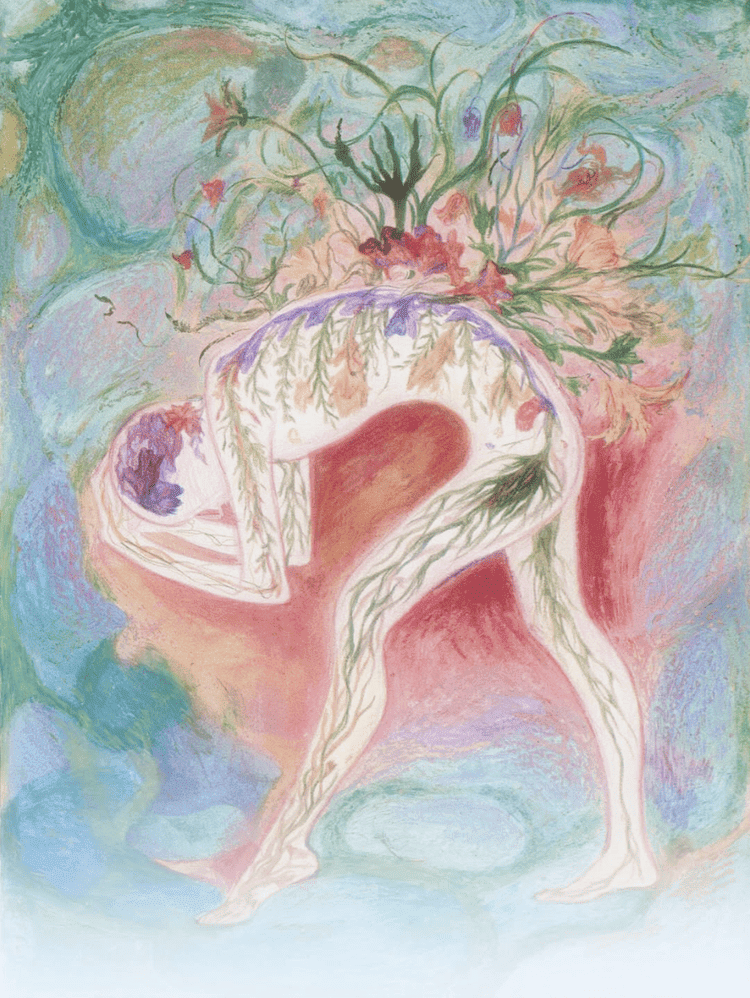
What a good-enough parental figure actually does
Picture the version of this that would work.
A child loses her favourite bear and runs to her mother in tears. A wise mother meets her exactly there. First, she witnesses: "Oh, you're so sad." The child feels seen. Then she reflects the meaning beneath the tears: "You love your bear so much." Now the child feels understood, not just observed.
From there, the mother regulates alongside her, holding the child through the intensity so her nervous system learns that this much feeling is survivable. Slowly, she tracks the shift — “I can see that you're crying less now" — and orients the child back to the room, the present moment. And only then does she lead: let's go look for the bear together.
Witness, reflect, regulate, orient, lead. This is the arc that helps a feeling move, and finally resolve.
“Yes, at the “absolute” level, we are pure awareness, the consciousness prior to form. But — and this is a cosmic BUT! — at the human, absolutely biological level, we are mammalian creatures, wired for closeness, co-regulation, and deep, safe attachment. Integrating those two absolute truths is where real “enlightenment” lives.
True spiritual maturity isn’t floating above the human condition in some kind of spaced-out, detached awareness. It is having the courage to embody this form completely, to land fully in this soft body, to honour our profound mammalian attachment needs, and to risk everything to love other human beings and animals.
And to let ourselves be loved in return.”
— Jeff Foster
Becoming your own steadier presence
This is the practice for those of us re-parenting ourselves in adulthood: to stop collapsing into the emotion as though we are it, and instead come into relationship with it. Not "I am grief," but "a part of me is in deep grief, and I am the one who can be with her." I've felt this myself in ceremony more than once, the exact moment grief stops being something happening to me, and becomes something I'm sitting with and can hold and witness instead. That shift from identity to relationship is everything.
That capacity to hold isn't something you build from scratch. It's something you recognise was there all along, underneath the identification that had convinced you otherwise. Interoception is what makes this recognition possible — it gives you the raw data of the arc itself, the exact moment the chest loosens, the breath lengthens. This is often where a skilled guide or somatic practitioner becomes essential: to be the regulated nervous system in the room until yours learns the pattern well enough to offer it to itself. This is, at its heart, the work I do with people in Somatic Inquiry sessions and at Symbiosis.
“For a long time, intense sensations in my body felt overwhelming and frightening, and I often felt alone with them. Through the retreat and Somatic Inquiry work, I learned to meet these sensations with more curiosity and compassion; to recognise them as a part of me, rather than something to fear or push away.
I know healing takes time, and that is the beauty of the journey. It allows me to witness new insights unfold, see old patterns from a new perspective, and meet myself with more love and kindness.
Why Stellar Folk? Because they meet you as humans, from a place beside you instead of above. You feel seen, understood, and safe to be exactly where you are. Their presence creates a space where connection, compassion, and love can unfold. A reminder that we are not separate. We are all connected.’’
— Rieke, participant of the Symbiosis retreat
Because that's the real aim — not to never need another human's steadying presence again; we are relational creatures, and we heal in relationship as surely as we were wounded in it. The aim is to slowly become someone who can witness their own grief, reflect its meaning to oneself, regulate through the height of it, notice when it starts to shift, and then, gently, lead oneself back into our day. Mirror, container and guide, all housed in one body that finally knows how to come home to itself, and held, underneath it all, by an awareness that was never actually in danger to begin with. Wow!
And these two approaches can co-exist and nurture each other along your path.
Initiation
Seen this way, our darker periods — grief, collapse, depression, burn-out, the seasons of life that ask everything of us — are not simply wounds to survive. They are initiations, asking us to meet what's inside us with more presence than we were ever shown how to offer.
This is what it means to become present. And, eventually, the incredible recognition, through direct experience, that the one paying attention was never separate from you at all.
And this is very, very good news…!
It is the diamond hiding in your pocket, as Gangaji would say.
All art on this page is by @lumiarctur