White Privilege and the Loss of Belonging
Born in Northern Europe, of white ancestry, I know I carry an ethnic, historical, and geographical privilege I did not earn. This is something I try to understand continually, and it’s also why I rewrote this essay at least twenty times, aware of the delicate, charged terrain I’m treading, and hoping to make it honest, rather than overreaching, while remaining relevant to my work as a facilitator.
So, friend, come along if you will, to witness me wrestle my whiteness.
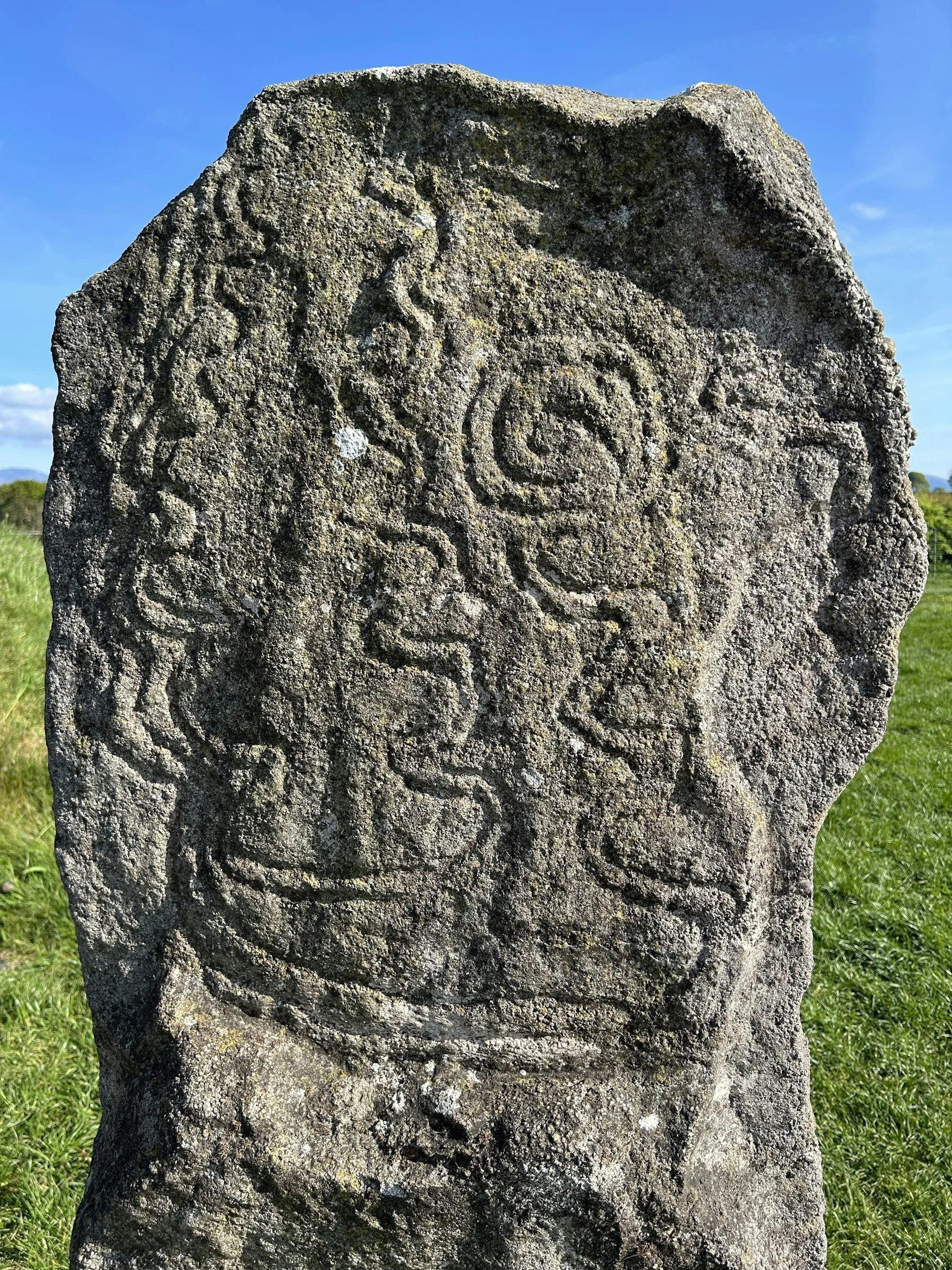
Bryn Celli Ddu is an ancient tomb on Ynys Môn (Anglesey). The passage is perfectly aligned with the summer solstice sunrise.
"There is no reason for you to try to become like white men and there is no basis whatever for their impertinent assumption that they must accept you. The really terrible thing, old buddy, is that you must accept them, and I mean that very seriously. You must accept them and accept them with love, for these innocent people have no other hope. They are, in effect, still trapped in a history which they do not understand; and until they understand it, they cannot be released from it. They have had to believe for many years, and for innumerable reasons, that black men are inferior to white men. Many of them indeed know better, but as you will discover, people find it very difficult to act on what they know. To act is to be committed, and to be committed is to be in danger."
– James Baldwin in The Fire Next Time
Sometimes I don’t know what to do with my whiteness. I’m not talking about taking on some version of Rudyard Kipling’s “white man’s burden,” the old colonial fantasy that white people must save or, heaven forbid, civilise others. If anything, it feels more like carrying an inheritance that is both uncomfortable and confusing, entangling me in ongoing harm. I don’t have neat answers, but I know this inheritance shapes how I meet the crises of our time. James Baldwin, American novelist, essayist, playwright, and activist, reminds us, “to act is to be committed, and to be committed is to be in danger.” How painful it might be, we need to deeply acknowledge and embrace our history.
Here’s a question I invite you to ponder on:
Would we even need healing in the ways we do now if privilege had not been constructed in the first place?
Alongside the awareness mentioned above sits something else I grapple with: that our European ancestral connection to earth, to ritual and to one another was also broken. Both of these realities — the legacy of privilege and the loss of rootedness — shape how I move in life and in the wellness space.
I keep returning to the thought that privilege itself was born from this disconnection. A severing from land, soil and season, from communal life, from meaningful ceremony and from kinship with our wider human family. As a white-bodied woman, I notice and feel how my own inheritance distances me from these bonds, even as I long for them. And I know, too, that every body carries ancestral stories and relationships with land and community. No matter our ancestry, perhaps we can each approach these questions with curiosity, respect, and care, letting them guide us toward a more honest form of personal and collective healing.
Lyla June’s reflections on reclaiming Indigenous European roots move me to tears every time I read them (and I read it at least once a year!). In her piece, she recalls that many of our ancestors once lived close to the land, with languages, songs, and rituals that honoured the living Earth. But that intimacy was broken.
Over the course of at least a millennium, the imperialism of the Roman Empire, the rise of the church as an instrument of control, the witch hunts that silenced medicine women and men, the enclosure of the commons — all of these stripped us of belonging.
When I sit with this history, I see how the trauma of it left us wandering, unmoored, and perhaps more vulnerable to becoming both perpetrators and victims of colonial violence. To dominate other peoples and lands is often the behaviour of those who have themselves been torn from their own ground. I can’t help but think of what is unfolding now in Palestine, and how cycles of disconnection and domination keep repeating.
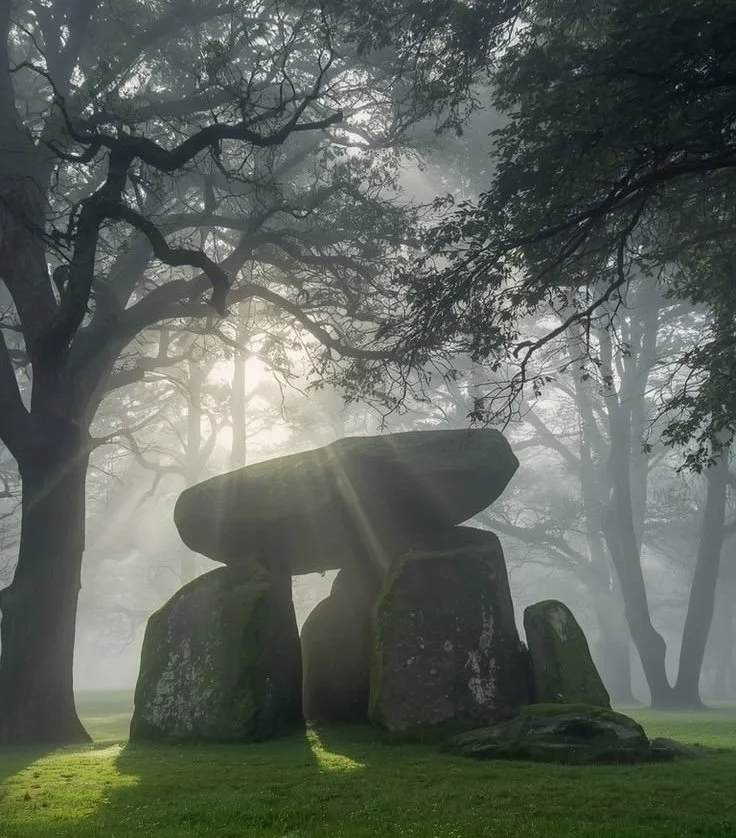
A Hunebed, a prehistoric megalithic tomb made of large stone boulders, built by the Funnelbeaker culture around 3000 BCE in what is now Borger, in the Netherlands, where I’m originally from.
Rites of Passage and Embodiment
Robin Wall Kimmerer, whose Braiding Sweetgrass I return to often as well, writes that to know the land as a teacher, as a relative, is to live in reciprocity. Without that bond, soil, rivers, forests — and by extension other human beings — become resources to be consumed. Is colonialism, at its core, the shadow of forgetting our original instructions?
And so we arrive in this industrial age, largely bereft of rites of passage.
Where once young people were guided through fire, water, fasting, and vision, now we stumble into adulthood uninitiated, reaching for numbing substitutes like alcohol, social media and endless consumption. I sense that without true initiation we remain adolescents in grown bodies, longing for elders who can show us how to live.
Embodiment feels like one way back to remembering. Our estrangement from land has also meant estrangement from the very soil of our being: our own bodies. When I lose touch with sensation, breath, or feeling, I also lose touch with the wider body of the earth.
Perhaps reclaiming our roots begins not only with history, but with the body itself: pressing bare feet into soil, allowing grief to rise in the chest, receiving joy as it ripples through the skin. In this way, embodiment itself becomes a rite of passage. An initiation into presence. Returning to the body, to our felt sense, is a doorway back into belonging.
Mushrooms as Elders
This is where the mushrooms come into my life’s work.
In ceremony, the fungi often feel like elders. They hold up a mirror to the self, showing both the trauma we carry and the wisdom buried in our bones. Participants sometimes describe a sense of homecoming. Not to a particular culture, but to the Earth herself. The mushrooms seem to show us that belonging is not about dominance, but about remembering that we are, literally, part of the Earth’s living mosaic. And, as they so lovingly guide us, we can arrive there through our bodies, when we allow ourselves to feel everything so deeply.
For those of us whose ancestral lines trace to Europe, reconnecting with our roots is not about borrowing or appropriating Indigenous traditions that are not ours. It feels more like a responsibility: to see clearly the legacy of unearned privilege, and to keep learning how to move with humility and accountability. I don’t believe these are optional. It seems like a lifelong practice and a necessary foundation for any genuine reconnection with ancestral ways and the Earth herself.
Still, in a culture so cut off from elders and earth-rooted ways, I find myself learning respectfully from living lineages from elsewhere, as reminders of what has been lost, and as teachers of reverence.
Tending the Wound to Walk Differently
At the same time, and perhaps more importantly, I try to listen for the traces of my own ancestors: the herbs my great-grandmother used, the seasonal festivals that honoured sowing and harvest (like the recent equinox), the fragments of old songs. And when I meditate or sit in ceremony, sometimes I can faintly hear the ancient songs Lyla June speaks of… All these fragments invite both grief for what was stolen and choice in how I walk forward, into my life and work.
Could it be that the healing of privilege is not just about facing and coming to terms with history, but about tending a very painful wound? We must now turn our attention to what can be done in the present. This looks like listening deeply and giving voice to those that have been silenced, supporting Indigenous-led initiatives, cultivating relationships of reciprocity with the land, sharing resources equitably, and examining the ways we benefit from systemic inequalities. American author, feminist, and social activist bell hooks (her pen name is deliberately lowercase), puts it as follows:
“Privilege is not in and of itself bad; what matters is what we do with privilege… we have to share our resources and take direction about how to use our privilege in ways that empower those who lack it.”
Perhaps this is the task of our time: to remember that we, too, come from people who once loved the land like kin. To reclaim even a fraction of that love may soften the structures of domination we were born into. And as we do, we may discover that healing our own roots is inseparable from the healing of the earth and all her peoples.
Maybe the healing of privilege is about learning to be guests of the Earth again, not her masters. One thing I know as a fact: ceremony — whether through plants, mushrooms, ritual, song or community — can re-initiate us into belonging to Her.
Resources:
Article: Lyla June’s essay Reclaiming our Indigenous European roots
Just read it. Trust me.
Book: Braiding Sweetgrass
Braiding Sweetgrass by Robin Wall Kimmerer is a lyrical and deeply reflective exploration of the relationship between humans and the natural world, written through the lens of Indigenous wisdom, botany, and personal storytelling. Kimmerer, a Potawatomi botanist, invites readers to remember the Earth as a generous, intelligent, and reciprocal being—one that gives endlessly and asks only gratitude and care in return. Through essays about plants, ceremony, and motherhood, she “braids” together Indigenous teachings, scientific knowledge, and the language of reverence, revealing how reciprocity, respect, and gratitude can heal our fractured relationship with the living world.
Article: Doppelganger
For context on Palestine, I recommend Naomi Klein’s article “Doppelganger Effect.” She writes:
“Since publishing Doppelganger* in September, 2023, some of the most gratifying feedback I have received has been about what one reader called “the Jewish parts.” These passages are mainly (though not exclusively) in two chapters that come late in the book: “The Nazi in the Mirror” and “The Unshakable Ethnic Double.”
*I heartily recommend you to read the book in its entirety.
Book: The Great Cosmic Mother
The Great Cosmic Mother: Rediscovering the Religion of the Earth by Monica Sjöö and Barbara Mor is a passionate, wide-ranging exploration of ancient matriarchal cultures and the suppressed history of goddess-centred spirituality. Drawing from archaeology, mythology, anthropology, and feminist theory, the book traces how early societies revered the Earth as a living mother—source of life, death, and renewal—and how patriarchal religions and capitalism severed that sacred connection. Both scholarly and visionary, it calls for a return to an embodied, ecological spirituality that honours the cycles of nature, the wisdom of women, and the sanctity of all life. A book that everyone should have on their shelf.
Short tv series: The Underground Railroad
This thrilling, genre-bending tale of escape from slavery in the American deep south adapted from the original book (the Pulitzer Prize-winning novel by Colson Whitehead under the same name) faces some deeply uncomfortable truths. Tapping magical realism and a superb cast, The Underground Railroad is an emotional and chilling triumph, speaking to the blood-soaked foundations on which the United States have been built. From Academy Award winner Barry Jenkins (Moonlight; If Beale Street Could Talk).
Book series: Boudica
If you’re drawn to historical fiction that intertwines spirituality, nature, and the complexities of identity, shamanic dream teacher Manda Scott’s Boudica series is a compelling read.
The series centres on Boudica, the real-life Celtic warrior queen who famously led her people against Roman occupation. In the first novel, Dreaming the Eagle, Scott brings Boudica (here called Breaca) to life, exploring her world where dreams and waking life merge, gods and ancestors are integral to daily existence, and individuals undergo rites of passage to discover their lifelong spiritual guides, or “dreamings.” This series offers a rich tapestry of Celtic mythology and a profound exploration of human connection to the land, the divine, and the courage it takes to reclaim one’s story.
I’m currently in the second half of the 4th and last book, and I’m deliberately reading it slowly because I don’t want it to end, haha.
“The elders were wise. They know that man’s heart, away from nature, becomes hard; they knew that lack of respect for growing, living things soon led to a lack of respect for humans too.”
Chief Luther Standing Bear
Chief Luther Standing Bear, Lakota Sioux elder, was an author, educator, philosopher, and advocate on behalf of Native sovereignty and culture. Raised in Lakota oral traditions, ‘‘educated’’ at Carlisle Indian Industrial School, and later active in writing and film, he dedicated his life to preserving Lakota heritage and resisting assimilation.
The Carlisle Indian Industrial School, founded in 1879 in Carlisle, Pennsylvania, was the first government-run boarding school for Native American children in the United States. Its stated mission was to “civilise” and assimilate Indigenous children into Euro-American culture—summed up chillingly by its founder, Captain Richard Henry Pratt, who declared, “Kill the Indian, save the man.” Children were taken, often forcibly, from their families and tribes, stripped of their languages, names, hair, and traditions, and subjected to military-style discipline and Christian indoctrination. While the school promoted itself as offering education and opportunity, it was in truth an instrument of cultural genocide and deep trauma, erasing Indigenous identity and severing ancestral bonds. More than 180 children died at Carlisle, many buried far from home. Today, the site stands as both a memorial and a reminder of the resilience of Indigenous peoples who continue to reclaim their languages, stories, and ways of being despite this brutal legacy.